
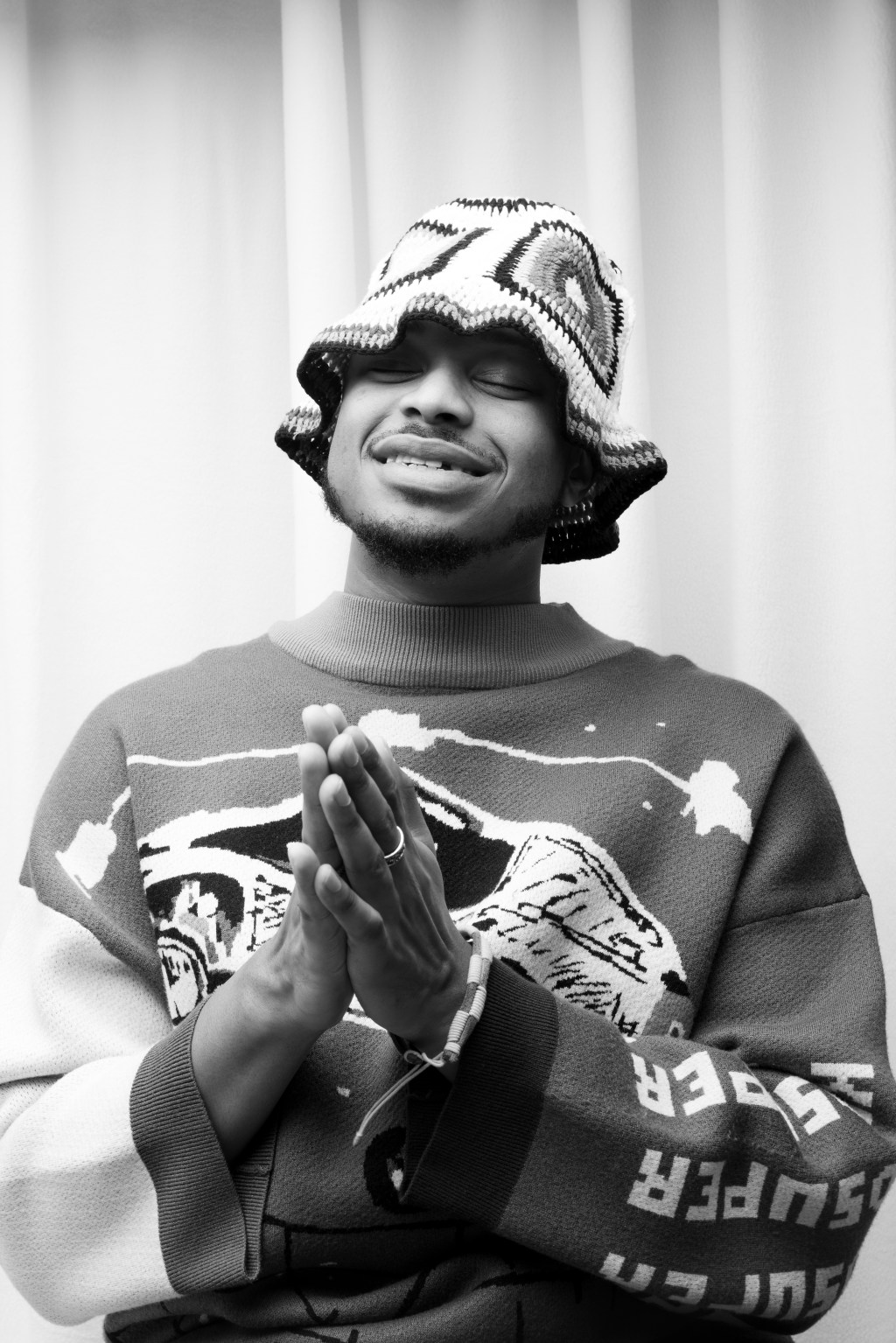
Following a two-year hiatus, INTHEWRITERSMIND is back starting with a special in-depth conversation with the one and only Kaelin Ellis…
For Kaelin Ellis, music is an extension of himself. It’s his everyday feelings, it’s the rhythm of his heartbeat, the motion in his lungs, it’s what he believes he was called to share with the world.
Born in Lakeland, FL with both Nigerian and South African roots, Kaelin has felt a call to music and rhythm from a young age. At two years old, he was playing drums in church and using his gifts for what he felt was a higher calling. As Kaelin matured he experimented with the genres his dad exposed him to growing up, fusing gospel with hip-hop, playing with the synths in electronic music and the soul of jazz. He has gained the attention of thousands of music lovers online who marvel both at his ability to edit videos in such a fascinating way and the unusually cool beats he conjures up from ideas in his bedroom.
As a multi-instrumentalist with the eye of a filmmaker, Kaelin works his way through Instagram, TikTok, YouTube and Twitch communicating directly with his fans with short form videos, building, nurturing and growing a strong community. This in-depth conversation followed his first EVER concert in London. Sitting in a restaurant in Central London, we discuss his most recent album You Are Here, Start., his tour, how gospel inspires his music bonding over a shared admiration for J Moss, what he learned from Stanley Kubrick and everything in between. We go deep. Very deep. Join us on this incredible journey…
Daniella: Kaelin, what a show! Your first show in London! I have been a big fan of your music for years, especially, your gift in hearing music in ways that people can’t and how you fuse this with amazing video production. It is an honour to speak with you today. How are you feeling after that incredible show?!
Kaelin: I wanna be honest and say I’m not depleted, but physically, I’m tired. It’s normal, but I’m good. I feel like I did what I was supposed to do. I’m very thankful and happy about how it all turned out.
Daniella: That’s totally understandable. There’s a lot that goes into touring that myself and other music listeners aren’t directly exposed to. I’ve seen musicians talk about the financial and emotional strain that touring can have. In 2022, Little Simz had to cancel her US tour, because it was a huge deficit for her. From your perspective, what has your experience been like touring around the world? Have you had to overcome any hurdles?
Kaelin: I would genuinely say since we began the tour in June, my team decided to do shows months apart. One of the things that I recognize about traveling so much is that it requires a lot of attention to detail in understanding logistics. Even overseas, because you can simply miss very important things, whether it’s the logistics of the actual tour or the toll that it takes on a person after time. Something as small as the interaction with the people that you really care about and the people that support you. Pretty much everybody that comes and sees me during my shows and tours are people within my community. I actually collaborate and work with the people that are coming to the shows, but also seeing them in person is like—a different kind of relationship.
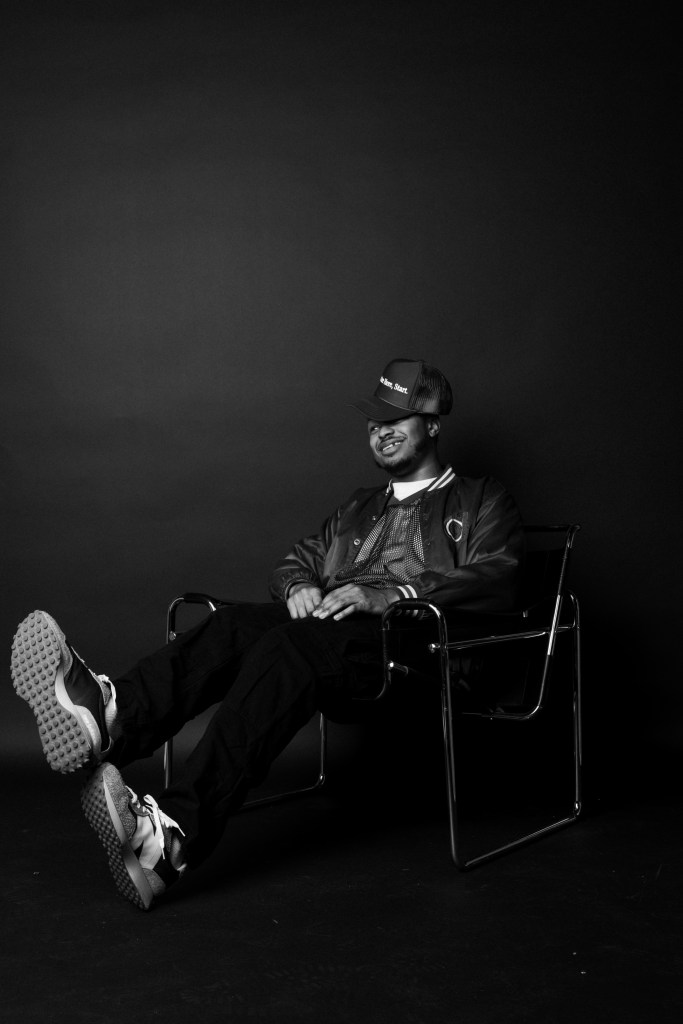
Something that happened in my first show is that Oh Gosh Leotus allowed me to borrow his drum kit. I did not even realize how much not having a team of people surrounding me that night was kind of like me moving like a chicken with my head cut off. I was moving everywhere without any kind of specific direction, because there were so many areas that needed to be attended to. I had the merch to tend to, the openers to attend to. I had all the different things about the show. Where do we go? Where’s the green room? Who’s communicating constantly? I realized sometimes it’s hard to focus on the art when you’re also focusing on business. And that’s what I think I recognize about tours in certain capacities. Not every show has been like that. I had certain shows where people were able to come and help out. I’m super thankful that my dad is here in London and Paris with me, because if he didn’t come, I don’t know how it would have turned out. It’s even better when you have people that are surrounding you that can help in any area. Anybody that decides to go down that route should definitely have a long conversation about logistics and how things work.
Daniella: That’s super insightful. I’m glad your dad is able to join you on this pivotal moment in your journey and it’s great to have him here with us too. You know, something I really love about your music is that it has so many different elements. There’s funk, there’s gospel, there’s hip-hop, there’s dance and I love how you bring all these elements together. You can see and hear the influences in your music. I remember in an interview you spoke about how you were playing drums in church at two years old! What gospel artists did you listen to growing up that you still listen to now?
Kaelin: Oh, man. So, Kim Burrell was my introduction to a lot of things. My dad played the Kim Burrell live in 1999 with the drummer from Snarky Puppy, “Sput” Searight and Shaun Martin. God rest his soul. He was the one that was playing keys at that concert. I didn’t realize how many people that played in those early gospel albums, are also playing in the jazz records. I just listened to all that very, very early. I started drawing connections between Kim Burrell, Kirk Franklin, Yolanda Adams, Donnie McClurkin—
Daniella: J Moss?
Kaelin: Yes!! J Moss.
Kaelin’s Dad: Oh my God, J Moss!
Kaelin: My dad is a heavy J Moss fan, J Moss is crazy. *sings* Can I have your attention, please?
Daniella: *sings* PAJAM!
Kaelin: That’s incredible, wow. Yeah man, PAJAM, Kierra Sheard. OMG, I could go down a whole list of The Sheard’s. Dorinda Clark, *sings* I’m Coming Out. Man, that was a great time. My mom was heavy into CeCe Winans. Her catalog from like the 90s, even Alabaster Box and after that. It was just “different thinking” gospel music at that time. That’s what I used to listen to every morning. So, I think that’s where my ear for what I like and what I wanted to create started.
Daniella: I love the way you speak about your upbringing with gospel music. I relate to your love of gospel. I grew up on gospel. My dad sang in church.
Kaelin: Wow.
Daniella: Something that people say a lot on social media is, “you can tell when a musician hasn’t grown up in church, you can hear it in their music.” Like there’s something that is almost missing. When I talk to my Black American friends, as a British Nigerian, when we both see a statement like that, we can both understand what they mean. It’s almost this unspoken kind of soulfulness and spirit that’s missing in the music. When you hear phrases like that, what does that actually mean to you? What do you think there is in a musician’s music, if they’ve grown up in church, that makes their music stand out?
Kaelin: Wow, I think the first thing that comes to mind is that growing up in church you play not to honor yourself, but to honor something far greater than you. When you play from that perspective, there’s something outside of you that is holding this whole cosmos together. It makes you think outside of the box for why things exist. I grew up thinking, what if we blended two things together that didn’t exist, because God is all about creation, right? So, if that’s the case and there was a void that was darkness, then shouldn’t we do that with our music? Shouldn’t we do that with how we create and give someone a different perspective? Isn’t that what creativity is? I think if people operate from that perspective, it’s like you’re serving something a little bit deeper than just playing something to make it sound good.
Recently I went to a retreat where everybody had that God encounter to a degree. It’s in their music and they chase that, whether they realize it or not. They’re really seeking God in what they’re doing. And that’s what’s missing, you know? When my dad used to teach me growing up, he was like, “oh, no, we’re not here for show. We’re here to do a very specific job. People are hurting and your gift is allowing that thing to be opened up and for God to fix it.” So, that’s what I think that means.
Daniella: Wow. I have friends who are Christian and make music. They always talk about the conflict in wanting to make faith-based music that reaches people, but also not wanting to be boxed in as a gospel artist. How did you make a decision on where your standpoint is, what you want your music to say and where you want to fit within ‘gospel’ or ‘secular’ music?
Kaelin: I remember being asked that question, is it secular or is it sacred? Something that I remember, Louis Armstrong—maybe it might have been him. I remember he was interviewed. They asked him, “how do you feel about jazz?” People know him as a great jazz trombonist. And one of the things he said was, ‘I am just purely making music’, you guys are trying to create a genre and specify what this is. But, in God’s kingdom you don’t separate people. It’s either you’re in or you’re out. If you’re in and you’re all in, then whatever you do, do it to honor God at the greatest capacity that you can. Because no matter what creative gift you use, it’s drawing people somewhere. Either you wanna draw it to him or you’re gonna draw it to yourself. That’s where God is like, I don’t want you to draw it to you. There’s a bigger plan, if you get yourself out of the way, that’s where God can do his thing.
I found that by getting myself out of the way, I allow God to open up things about music that I didn’t even know. I met people from so many different parts of the planet that were like, what you do on Twitch stream and how you create has opened up what I have been looking for. God has been allowing me to create what I create to open up their gift. So, it’s not even about me. I’m not even the reason. Come see me at the show. Cool. I appreciate the support, but at the end of the day, it’s about you take from what I’m doing.
How does this apply to you?
Somewhere in the middle of it. God is usually going to whisper something in somebody’s ear to try something, that little like—I got the idea. I talked to so many people tonight that mentioned what I did with my sound packs. What I did with my music has given them a different perspective. Me in my room making music and worshipping God, creating in a way that I know how to worship God—I’m not thinking too much outside of that. What could happen outside of this room? It’s been happening for a while and coming here to London for the first time and seeing it in person. So many people came up to me and was like, “yo, because of that idea you had, I now feel like I can do it too.” That’s the whole purpose. It’s not about me. I believe that I am a part of the God’s plan and God includes us all in His plan. And when the time is over, it’s over. But until then, do what you gotta do. That’s how I see it.
Daniella: That’s incredible. Thinking about creativity and experimentation, I loved when you experimented with South African music, specifically amapiano. I just thought that was very brave of you to do and move out of your comfort zone. I wanted to talk about that. What was the process behind that feeling of coming out of your comfort zone?
Kaelin: Man, so I’ve always been into South African music. Especially after discovering about my Nigerian side of the family. The West and South African influences in my family especially on my dad’s side. I realized that I am 95% Black, I have Africa in my DNA. So, I started learning about my lineage and where I’m from. I played drums in church and there’s things about when I play drums in church that is kind of unexplainable. You know, I grew up having these moments, in ways that they would talk about it with James Brown records, where they’d say he would get into a trance. He would go from this thing where was in the zone to gone and gone would be playing that same pattern over and over again. Kind of like they do in church, but also like going back to traditional African music. I never knew about the origin of rhythm and where it comes from in my family.
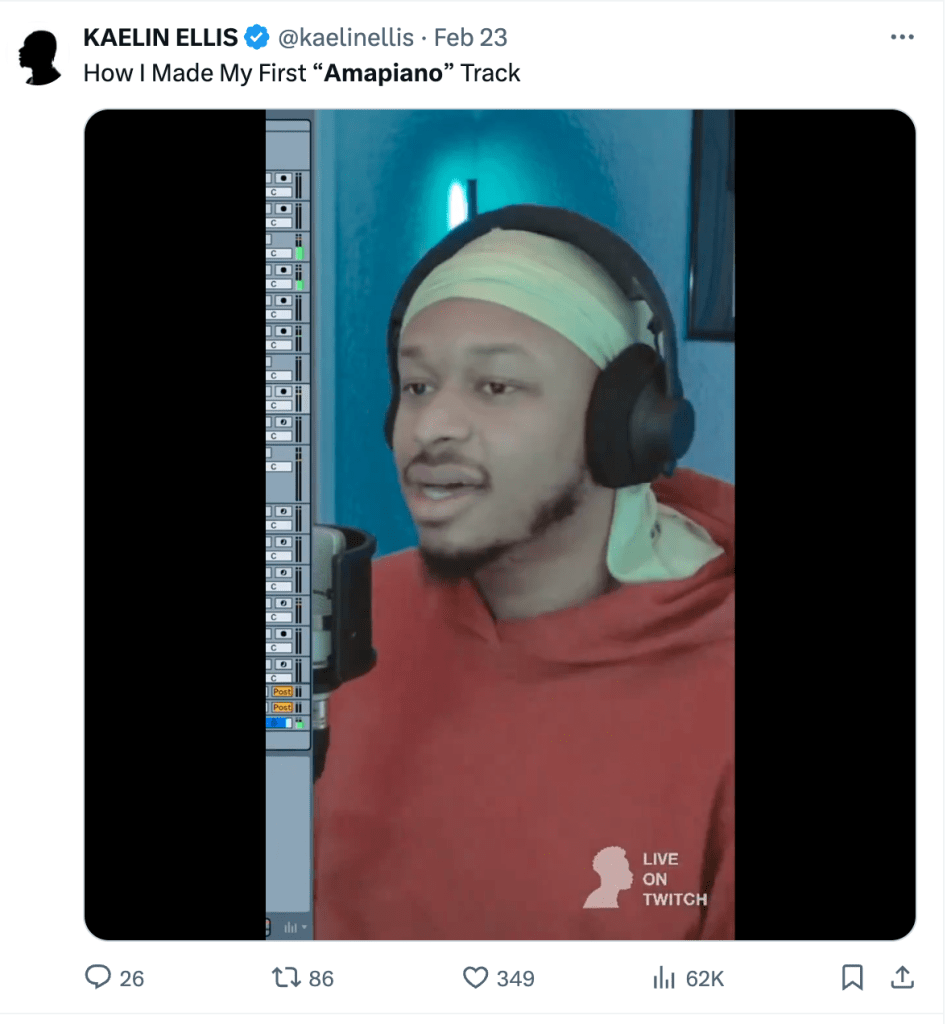
I started learning about my lineage, started learning about amapiano and the house style of music that came before. I started learning about those different styles and OMG, how I play drums in church literally sounds like this. It’s integrated in how I’m playing rhythms. I will literally stay on a loop if I really like it for hours. Like all of my music. I’ll play a groove for hours, because it is so sticky. That’s why, one of my favorite records is The Bar-Kays – Holy Ghost. In the middle of it, it’s like (Kaelin recites the drum pattern) if you take away the regular drum beat, that is Afro. That’s African. This year specifically, I wanted to try to get out of my comfort zone and try something different. I tried amapiano and then having that experience with Twitter responding to one of the videos I did, it made me like maybe I should deep dive into the history of it.
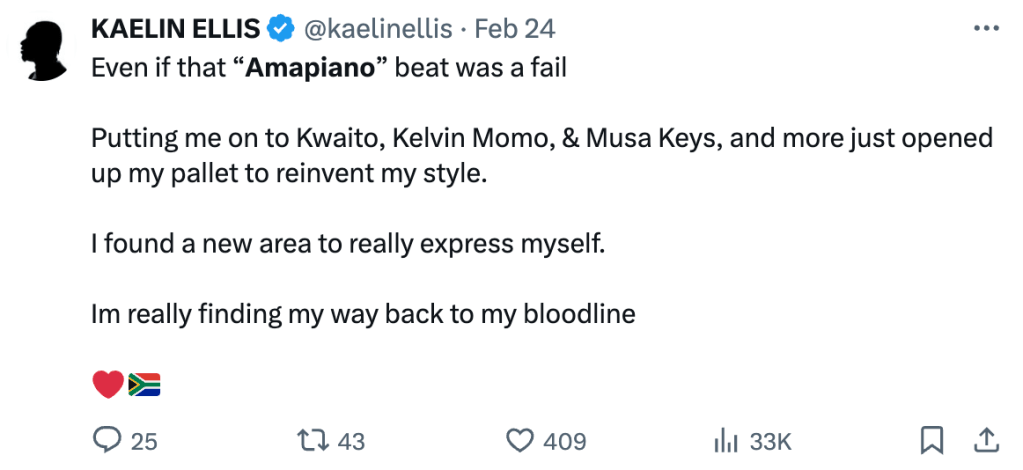
I started learning about the origins of amapiano. There’s a whole documentary on YouTube talking about that transition when it went from this style of house to amapiano. Then I also met a guy who teaches amapiano on YouTube, who goes by Amapiano Academy. He shows how to make those same sounds on Ableton! So, then I got very curious about trying other things. This is a crazy thing too, but Florida, where I live, that great piece of Florida used to be a part of Africa at one point. That messed me up, because before Pangaea, Florida was a part of Africa. When I look at how people describe Africa and I look at Florida, I’m like, there’s something about Florida that’s just interesting. I’ve just always been curious to try different things.
Daniella: You took us on a journey, I love that answer. You know, we’ve got so much incredible music from you. We had Moments in 2020. We had The Funk Will Prevail in 2022. We got You Are Here, Start. this year. Take us through that album, what do you want listeners to feel when they listen to that?
Kaelin: The Funk Will Prevail and You Are Here, Start. literally happened in the same year. When I was finishing The Funk Will Prevail, I was trying to figure out how to extend certain parts of the record. In 2021, a month later, after I finished the second half of that project, I ended up going to LA. I met everybody and we essentially created like 25 records, but half of those didn’t end up on the album. So, You Are Here, Start. was made years ago. My team was like, these songs are great, you should drop this. But, I never did. I sat on it for a long time. I wasn’t even thinking about dropping the album this year, because I went through a whole transformation in my life. In 2020, I was engaged to a really good friend of mine at that time. It just didn’t pan out for the both of us. Towards the end of it, that’s when I started becoming more clear on what I wanted out of my life. I started becoming more aware of what I wanted to say and I ended up meeting a really solid woman.
But, in the process of growing out of that situation. I was trying to figure out where I should go from here. Then I realized the body of music that I made literally had the secret to what I needed to do, which was to move on from that project. It was about starting over, starting fresh and realizing that there’s more. So, I realized each project I have has a different lesson attached to it. I feel like a lot of people are like, ‘oh, I want to try this, but I don’t have the knowledge, the information or the time.’ But, if people really want to try something and they are really adamant about a dream that they have, then they will find a way to make it work. Even if you don’t have an answer right now, you can tell yourself, I’m gonna figure out a way to do this. As soon as I got serious about what I wanted, everything just started to just naturally develop. I met the person that was perfect for me, allowing me to grow and understand where God has me right now. So, anybody that listens to You Are Here, Start., it’s literally about starting where you are and not allowing anything to get in the way of that. You can start small, you can start big, but just start.

Daniella: I love seeing you collaborate with other musicians, like Iman Europe, Anomalie, The Kount and ROMderful. How do you decide who to make music with, what is the process like?
Kaelin: Every once in a while, I come across people that say something in a way that I would have said it, but better. Romderful is one of those dudes. Gareth is one of those guys. It’s like, I hear things the way that they’re hearing it. It can either be an indication that maybe it’s a coincidence or maybe this is something that you need to connect to. It can be a collaboration or just a friend. I’ve never gone into a relationship with people like, ‘oh, let’s collaborate on something.’ That never works. There has to be a deep connection. I’ll talk on the phone with them. That’s how I had gotten literally every one of my features on the album. I literally hung out with Duckwrth. I didn’t know Duckwrth and Channel Tres were family members. And that’s when I was like, ‘oh, shoot, it’d be cool if Channel Tres comes by while we finish this song.’ And he goes, ‘sure, that’s my cousin.’ Every person I’ve collaborated with I had a relationship with. It’s not just because it sounds great on paper. Like Saba legit called me and was like, ‘bro, that song is perfect. There’s nothing we need to do for Heart.’ Nothing. That’s how I pick a lot of my collaborators. They just speak the same language.
Daniella: Are there any artists, bands or producers that you would love to work with that you haven’t already?
Kaelin: Kindelan is great! Gareth of course, he’s great. Laila! has been crushing it and to find out she’s Mos Def’s daughter! I was like, what? That’s crazy. I would love to get in the room with ENNY and make something with her again. She did a freestyle over one of my tracks during the pandemic, and that was IT. I was like if we got in the room together we would make something crazy. Man, I also want to work with more international people, more folks overseas too.
Daniella: So, a couple months ago, I saw Masego perform in London. He made a beat on stage and his whole process just reminded me of Ryan Leslie. In true journalist style, when I got home I did some digging online to see if there were any references to Ryan Leslie being an inspiration for him. That’s when I discovered all these tweets of him talking about how Ryan Leslie is his main inspiration and it was so cool to see that connection. Which music legends do you draw inspiration from?
Kaelin: I’m going to try and pick from the not so obvious ones. So, Just Blaze. What I love about Just Blaze is the fact that he had a very distinct sound back in the 2000s. Like you knew it was his drums, you knew it was his style, you knew it was his sounds. I used to play a lot of video games. Just Blaze literally created a lot of the video game content for EA Sports video games. I didn’t know Tiger Woods and NBA Street have rare Just Blaze beats on it. These beats would typically run in the menu as you’re probably going to the bathroom or grabbing a snack. The beats are just playing in the background. Just Blaze by far is the craziest. His ear for just trying things was always like—let’s take soul, but make it sound like this. Let’s sample a gospel scream, pitch it, play with it and make it sound like an instrument.
Just Blaze, Rodney Jerkins (Darkchild)—he played a lot of his songs. Minor. I love minor chords like dark, moody…make you feel something kind of chords. And then there’s James Blake. When I was in high school, before he started singing, his name was Harmonimix. He used to remix stuff like Destiny Child’s Bills. He would take a song and literally harmonize what the person was singing through the production. This is before he started taking his voice and doing it with the production. But to hear him do it with production was like, yo, this dude is singing through the music! Then you hear him sing and it’s like, oh, the way he sings is how he samples his voice. James Blake was one of those guys that made me feel that you could take anything and turn it into whatever you want.
Daniella: Love how you broke that down. I also love how music feeds into the way you edit videos. Why is visual storytelling so important for your music journey and how you share your music with the world?
Kaelin: Well, it was one of those things where I didn’t recognize if it was important. When you think about music videos, it’s like a budget, you have someone edit it and color grade it. You ask yourself, what are you shooting? What is the storyline? When I was in the beginning, all I wanted to figure out was, how can I get people to see what I’m seeing? Getting people to feel what I feel when I make music. So originally it was just a loop. I would just put the camera in front of me on a stand. Then I thought, how can I go deeper than that? That’s when it started to click. I needed to have a reference. I realized that if I sample from music, I could probably apply that same concept to other things. Some of the greatest TV shows have all referenced some famous movie scene in it, especially The Matrix. That’s one of the greatest films ever. And then there’s Koyaanisqatsi, a random documentary that came out in the 80s. It filmed the entire world in the 70s in slow motion with orchestra music attached to it. Everybody was just moving in slow motion and never realizing it. The next few scenes in the film are timelapse scenes of New York City in the 70s. And I liked the fact that it had a certain kind of feel to it, like film. I want people to watch a movie when I make music, I want people to feel like they’re watching a movie. That was like a whole thing.
Stanley Kubrick shot films with the slow zoom in and I never realized what happens when you slowly zoom into a frame. What you’re zooming into becomes a lot larger than life. Everything around it doesn’t even matter. That was when it started to snowball. And so all of my beats, I felt like I was getting to this tension where I’m hitting certain parts, and I felt like things were coming in, coming out. And I’m like, oh, this looks cool! But like, how does this work though?
I never put things together until I realized that music is best when you’re in motion. So, think about life. Think about breathing—
[It was at this moment, that someone drives up to the restaurant blaring Teejay – Drift]
Kaelin: That’s a great song!
Daniella: Such a tune!!
Kaelin: So, yeah, when you breathe in and out, your lungs are moving. That’s motion. There’s that repetition of in and out. Life comes from motion. If you want to put life into something, you have to create motion. If you’re not moving, are you really living? That was a big question for me. I started asking myself why. So, with video editing, it’s simply motion that creates life. If you want something to have some motion, make something move. All of my music has some sort of motion to it, whether it’s a percussion element, then it goes into a riser and something drops out. I want what you see to drop out or have a rise. The rise can be a zoom in. The more you zoom in to something, it’s like whoever’s editing this is really grabbing your attention. It makes the person watching it really have to engage with the art. So, if you put motion in something people are going to pay attention.

Daniella: What’s next for you and what are you working on currently?
Kaelin: I have two albums that I’ve been working on and it’s actually been inspired by the shows. ‘Outside Music’ is a concept that I’ve been working on and another album that is basically blues and jazz inspired called ‘Mirrors’. It’s more so Floridian and realizing that the whole world is a mirror. Everything is a mirror. Our perception, the way we do things, the music we take in, how we feel about ourselves. It’s all a mirror. What I want to be able to do is creatively tell a story about where I’m from. I come from a city called Lakeland. There’s 37 lakes in Lakeland. All the lakes are like a mirror. How can I mirror my environment in the music? That’s my challenge right now.
All the ideas that happened with The Funk Will Prevail and You Are Here, Start., were all challenges. Especially, listen to your heart, I feel like that song was speaking to me. So I’m like, man, how can I hear more of what God wants me to say versus what I want to say? I think that’s what this era is for me creatively with my art. I wear the blue hat, the clothes, I have all these ideas that come at like 3:00am in the morning. Like fully developed ideas and even a plan to do it. I don’t get a lot of those unless it’s something specific. That’s what’s happened with every single project I’ve dropped. There’s always been something specific that has been placed on my path. Whatever this is, God is challenging me to do more. You Are Here, Start.
[END]
This interview with Kaelin is a long read and our conversation even continued beyond this interview. I enjoyed a drive round London with Kaelin and his dad where we discussed music, creativity and celebrated a plethora of producers bold enough to share their sound on platforms like Soundcloud and Bandcamp for the world to hear for years. I end this interview taking a moment to honour some of the producers who have and continue to change the game. Thank you Nameless, K Le Maestro, See Dee, Jake Milliner, Oh Gosh Leotus, ROMderful, Keifer, Wayne Valentine, eu-IV and many many more…
 INTHEWRITERSMIND